



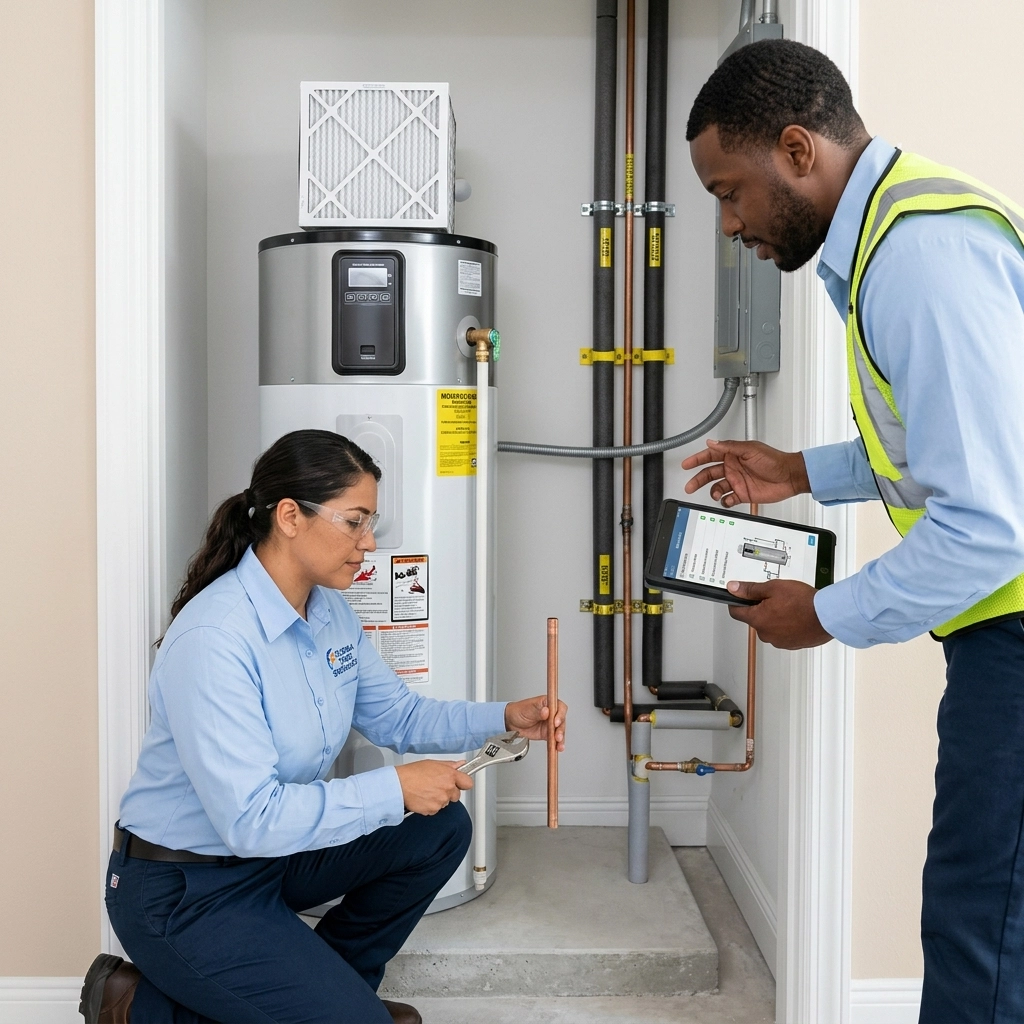
Water heater installation in Florida is a code and safety project
Water heater installation Florida work fails for two reasons. Code misses. Safety misses.
Florida adds pressure. Heat. Humidity. Corrosion. Storm outages. Hard water in many areas.
Wrong install results in:
- Scald risk
- Flood damage
- Gas leak risk
- Carbon monoxide risk
- Electrical fire risk
- Failed inspection
- Void warranty
The right plan prevents all of it.
Need a verified trade fast. Use a single network. Use Florida Trade Specialists. Start here: Florida Trade Specialists.
Disclaimer. Requirements and permits vary by jurisdiction. Always verify with local authorities or a licensed Florida Trade Specialists professional.
Water heater types decide cost, speed, and inspection outcome
Match the heater to the house. Match the heater to the utility. Match the heater to the install location.
Tank water heaters are simple and common
Tank units store hot water. They install fast. They cost less up front.
Key traits:
- 40–80 gallon sizes
- Electric or gas
- Lowest complexity
- Highest standby loss
Tankless water heaters are space-saving and demand-based
Tankless units heat on demand. They reduce standby loss. They demand higher electrical or gas capacity.
Key traits:
- Compact footprint
- High flow sizing required
- Scale sensitivity
- More permit triggers
Electric vs gas is a trade coordination decision
Electric units involve wiring, breakers, and sometimes service capacity.
Gas units involve venting, combustion air, and gas piping.
What fails first:
- Electric: undersized circuit
- Gas: improper venting
If your search is “plumber near me,” that is only step one. Water heaters in Florida regularly require plumbing, electrical, and sometimes HVAC-style venting knowledge.
Florida-specific factors change the install requirements
Florida installs are not generic installs.
Corrosion and salt air drive material choices
Coastal counties punish steel and cheap fittings.
Plan for:
- Dielectric unions
- Quality stainless flex lines
- Drain pans with proper discharge
- Expansion control
Hard water drives maintenance and lifespan
Scale kills elements. Scale clogs tankless exchangers.
Plan for:
- Flush schedule
- Anode rod checks
- Filtration or softening where needed
Storm outages change the best “fuel” choice
Frequent outages push some homes toward gas or hybrid planning.
Plan for:
- Surge protection
- Proper bonding and grounding
- Generator transfer considerations
Electrical work can trigger an electrical panel upgrade florida project. Breakers matter. Load calculations matter.
If the panel is outdated, circuit work becomes mandatory. Learn the service side here: electrical panel service upgrades.
Permits and inspections decide whether the job is finished
A working heater is not a finished job. A passed inspection is the finish.
Florida jurisdictions vary. Permit triggers vary by city and county. Inspection points stay consistent.
Common inspection focus:
- T&P valve installed correctly
- Discharge line routed correctly
- Pan and drain where required
- Venting and combustion air on gas
- Electrical circuit sizing and disconnect
- Bonding and grounding
- Strapping and clearances
- Shutoff valve access
Code references change by edition and municipality. Use the official baseline. Start at the state portal: Florida Building Code.
The pre-install checklist prevents call-backs and water damage
Do these checks before the old unit moves.
Sizing is a math problem
Confirm:
- Household size
- Peak simultaneous use
- Fixture flow rates
- Recovery rate needs
Rules that matter:
- Too small = cold showers
- Too large = wasted energy
Location rules drive safety
Confirm:
- Clearance for service
- Drain pan fit
- Safe discharge route
- No blocked access
- No electrical hazards
Garage installs require impact protection in many setups. Closet installs require airflow. Attic installs require serious drainage planning.
Shutoffs and protection are non-negotiable
Confirm:
- Cold water shutoff works
- Main shutoff accessible
- Drain path exists
- Dedicated electrical disconnect where required
If you already have moisture problems, stop. Confirm the source first. Leak confusion leads to repeated damage. Use professional leak detection florida workflows. Reference guide: 7 mistakes you’re making with leak detection in Florida.
The install process has zero room for shortcuts
Below is the standard workflow. It stays the same. The details change by heater type.

Step 1: Lock out power or gas
Actions:
- Electric: turn off breaker
- Gas: shut gas valve
- Verify zero power with a tester
Failure results in:
- Shock
- Arc flash
- Gas release
Step 2: Shut water and drain the tank
Actions:
- Close cold inlet valve
- Open a hot faucet to vent
- Connect hose to drain valve
- Drain to approved location
Drain pan overflow during removal is common. Control it.
Step 3: Disconnect plumbing and power
Actions:
- Remove hot and cold connections
- Disconnect electrical whip or conduit
- Cap gas line if applicable
Do not reuse questionable parts.
Do not reuse:
- Old T&P valve
- Corroded flex lines
- Damaged vent sections
Step 4: Set the new unit level and protected
Actions:
- Place in pan
- Level with shims
- Confirm access clearances
- Confirm seismic or strapping requirements if enforced locally
Attic installs need a real plan. Pan. Secondary drain. Safe discharge route. No exceptions.
Step 5: Install T&P valve and discharge line
T&P is the safety valve. It prevents overpressure and explosions.
Requirements commonly enforced:
- Correct valve rating
- Full-size discharge piping
- No upward traps
- Termination to approved location
- No caps or plugs
Step 6: Connect water piping correctly
Best practice items:
- Dielectric transitions
- Heat trap fittings if specified
- Proper thread sealant
- No cross-threading
- Support pipes to prevent stress
After connections:
- Open cold supply
- Purge air at hot faucets
- Confirm full tank before energizing electric elements
Energizing an empty tank burns elements. Immediate failure.
Step 7: Handle venting and combustion for gas units
Gas-specific requirements:
- Proper vent diameter
- Correct draft hood placement
- Approved vent material
- Secure joints with screws
- Verified draft under operation
- Combustion air sized correctly
Bad venting results in:
- Carbon monoxide entry
- Sooting
- Flame rollout
Step 8: Restore power and test
Testing steps:
- Check all joints for leaks
- Confirm thermostat settings
- Verify heating cycle
- Confirm T&P discharge line remains dry
- Confirm no backdraft on gas
Set temperature to a safe baseline. Many homes use 120°F. Scald risk increases with higher settings.
Electrical requirements drive hidden costs in Florida homes
Electric water heaters are heavy electrical loads.
Common requirements:
- Dedicated circuit
- Correct wire gauge
- Correct breaker size
- Proper grounding
- Proper bonding
If the panel is crowded or obsolete, the right fix is not “make it fit.” The right fix is capacity.
This is where circuit breaker replacement florida and electrical panel upgrade florida work shows up. A water heater install can expose unsafe breakers and double-taps.
If electrical credentials cannot be verified, the listing is denied.
If credentials cannot be verified, the listing is denied.
If credentials cannot be verified, the listing is denied.
Florida Trade Specialists routes the right licensed trade to the right scope. Not a guess.
Common failures Florida inspectors and homeowners see
Most “new water heater problems” are installation problems.
Leak failures are basic workmanship failures
Typical sources:
- Loose unions
- Cross-threaded nipples
- Missing dielectric separation
- Over-tightened flex connectors
- No support on pipes
A slow leak becomes structure damage. Drywall. Flooring. Mold.
If water appears and the source is unclear, use leak detection florida services. Do not cut walls blind.
No hot water failures are wiring or filling failures
Typical causes:
- Breaker off
- Burned elements from dry-fire
- Miswired thermostat
- Incorrect voltage
A “plumber near me” call is not always enough. Electric troubleshooting is electrical work.
Odor and soot failures are venting failures
Typical causes:
- Wrong vent pitch
- Blocked flue
- Negative pressure room
- Improper hood alignment
If you smell gas, stop. Leave the area. Call an emergency plumber florida dispatch and the gas utility where applicable.
Efficiency upgrades that matter in Florida
Florida energy bills are already dominated by cooling. Hot water still matters.

High-impact upgrades:
- Heat pump water heater where space allows
- Pipe insulation on hot runs
- Smart recirculation control
- Low-flow fixtures with proper balance
This is also where HVAC overlap appears. Heat pump water heaters change air movement and temperature in garages and utility rooms. Florida homes already run hard on cooling.
If your system struggles, solve the big driver. Use ac repair florida diagnostics. Plan air conditioning installation florida upgrades when equipment is old or undersized.
Multi-trade home projects stack fast in Florida
Water heater replacement often reveals bigger home system risk.
Common add-ons discovered during installs:
- Shutoff valve replacement
- Corroded supply piping
- Outdated electrical panel
- Damaged drywall from past leaks
- Poor ventilation in closets
Exterior protection matters too. Storm season punishes weak envelopes.
Related Florida upgrades that affect risk:
- impact windows florida for wind and water intrusion control
- roof replacement florida when shingles, underlayment, or decking is compromised
Water inside the home is not a single-trade issue. It becomes electrical. It becomes HVAC. It becomes building envelope.
If you are planning bundled work, review multi-trade options here: home rework and bundled projects.
Service coverage in Florida stays county-specific
Florida permitting is local. Contractor rules are local. Inspection schedules are local.
Florida Trade Specialists supports homeowners across multiple counties, including:
- Polk County, FL trade services
- Pinellas County, FL trade services
- Orange County, FL trade services
- Lee County, FL trade services
Water heater installation Florida FAQs homeowners need answered
How long does a typical replacement take?
Straight swaps can be same-day. Complications extend timelines.
Schedule drivers:
- Permit issuance
- Electrical modifications
- Vent corrections
- Platform and pan rebuilds
Do I need an expansion tank?
Some jurisdictions require it. Some plumbing setups require it based on system design.
Triggers include:
- Closed plumbing systems
- Check valves or pressure regulators
- High pressure conditions
What temperature should I set?
120°F is a common safety baseline. Higher settings increase scald risk and energy use.
Households with special needs should follow manufacturer guidance and code requirements.
What are signs I need replacement, not repair?
Replace when you see:
- Rusty water
- Tank leaking
- Repeated element failures
- Age beyond expected service life
- Burner or vent failures on gas
The success formula is licensed work, verified scope, and passed inspection
Water heater installation Florida success has a single definition. Safe operation. Code compliance. No leaks. No callbacks.
Non-negotiables:
- Permit alignment
- Proper T&P discharge
- Correct electrical circuit
- Correct gas venting
- Verified leak-free connections
When the job touches plumbing, electrical, and HVAC adjacency, separate scheduling fails. Scope gaps form. Liability transfers to the homeowner.
Assign the job to a coordinated network. Use Florida Trade Specialists. Book verified service at: floridatradespecialists.com